Crating Custom Templates
In some cases, you may want to create your own custom template. To do that, inherit one of the predefined templates and override some of its properties.
OrgChart JS visual components
You can customize the following OrgChart JS components:
- Node
- Fields
- Image
- Link
- Node menu button
- Expand/Collapse button
- Menu button
- Move icon
The first thing you need to do is inherit one of the existing templates:
OrgChartJS.templates.myTemplate = Object.assign({}, OrgChartJS.templates.@{@Model.DefaultTemplate});Node customization
To change the color, shape, or size of the node, define node and size.
Here is an example:
OrgChartJS.templates.myTemplate.size = [200, 200];
OrgChartJS.templates.myTemplate.node =
    '<circle cx="100" cy="100" r="100" fill="#4D4D4D" stroke-width="1" stroke="#aeaeae"></circle>';
OrgChartJS.templates.myTemplate.defs = '';
You will also need to modify the ripple configuration: color, radius, and rect.
OrgChartJS.templates.myTemplate.ripple = {
    radius: 100,
    color: "#e6e6e6",
    rect: null
};
Or you can disable the ripple:
OrgChartJS.templates.myTemplate.ripple = {
    radius: 0,
    color: "none",
    rect: null
};
Field customization
To change the fields, define field_0 and field_1. You can define as many fields as you want.
OrgChartJS.templates.myTemplate.field_0 =
    `<text style="font-size: 24px;" fill="#ffffff" x="100" y="90" text-anchor="middle">{val}</text>`;

OrgChartJS.templates.myTemplate.field_1 =
    `<text style="font-size: 16px;" fill="#ffffff" x="100" y="60" text-anchor="middle">{val}</text>`;
You can rotate the text using transform.
OrgChartJS.templates.myTemplate.field_0 =
    `<text width="230" transform="translate(300, -70) rotate(90)" style="font-size: 18px;" fill="#fff" x="125" y="95" text-anchor="middle">
        {val}
    </text>`;
Image customization
To change the position of the image, define img_0.
OrgChartJS.templates.myTemplate.img_0 =
    `<clipPath id="ulaImg"><circle cx="100" cy="150" r="40"></circle></clipPath>
    <image preserveAspectRatio="xMidYMid slice" clip-path="url(#ulaImg)" xlink:href="{val}" x="60" y="110" width="80" height="80"></image>`;
Link customization
To change the links between nodes, override link.
OrgChartJS.templates.myTemplate.link =
    `<path stroke="#686868" stroke-width="1px" fill="none" data-l-id="[{id}][{child-id}]" d="M{xa},{ya} C{xb},{yb} {xc},{yc} {xd},{yd}" />`;
Node menu button customization
To change the position and shape of the node menu button, define nodeMenuButton.
OrgChartJS.templates.myTemplate.nodeMenuButton =
    `<g style="cursor:pointer;" transform="matrix(1,0,0,1,93,15)" data-ctrl-n-menu-id="{id}">
        <rect x="-4" y="-10" fill="#000000" fill-opacity="0" width="22" height="22"></rect>
        <line x1="0" y1="0" x2="0" y2="10" stroke-width="2" stroke="rgb(255, 202, 40)" />
        <line x1="7" y1="0" x2="7" y2="10" stroke-width="2" stroke="rgb(255, 202, 40)" />
        <line x1="14" y1="0" x2="14" y2="10" stroke-width="2" stroke="rgb(255, 202, 40)" />
    </g>`;
Expand/Collapse button customization
To change the shape and color, define plus, minus, and expandCollapseSize.
OrgChart.templates.myTemplate.plus =
    `<rect x="0" y="0" width="36" height="36" rx="12" ry="12" fill="#2E2E2E" stroke="#aeaeae" stroke-width="1"></rect>
    <line x1="4" y1="18" x2="32" y2="18" stroke-width="1" stroke="#aeaeae"></line>
    <line x1="18" y1="4" x2="18" y2="32" stroke-width="1" stroke="#aeaeae"></line>`;

OrgChart.templates.myTemplate.minus =
    `<rect x="0" y="0" width="36" height="36" rx="12" ry="12" fill="#2E2E2E" stroke="#aeaeae" stroke-width="1"></rect>
    <line x1="4" y1="18" x2="32" y2="18" stroke-width="1" stroke="#aeaeae"></line>`;

OrgChart.templates.myTemplate.expandCollapseSize = 36;
Menu button customization
To change the shape and color, define menuButton.
OrgChartJS.templates.myTemplate.menuButton =
    `<div style="position:absolute;right:{p}px;top:{p}px; width:40px;height:50px;cursor:pointer;" data-ctrl-menu="">
        <hr style="background-color: rgb(255, 202, 40); height: 3px; border: none;">
        <hr style="background-color: rgb(255, 202, 40); height: 3px; border: none;">
        <hr style="background-color: rgb(255, 202, 40); height: 3px; border: none;">
    </div>`;
Move icon customization
To change the tree move icon, define pointer.
OrgChartJS.templates.myTemplate.pointer =
    `<g data-pointer="pointer" transform="matrix(0,0,0,0,100,100)">
        <g transform="matrix(0.3,0,0,0.3,-17,-17)">
            <polygon fill="rgb(255, 202, 40)" points="53.004,173.004 53.004,66.996 0,120" />
            <polygon fill="rgb(255, 202, 40)" points="186.996,66.996 186.996,173.004 240,120" />
            <polygon fill="rgb(255, 202, 40)" points="66.996,53.004 173.004,53.004 120,0" />
            <polygon fill="rgb(255, 202, 40)" points="120,240 173.004,186.996 66.996,186.996" />
            <circle fill="rgb(255, 202, 40)" cx="120" cy="120" r="30" />
        </g>
    </g>`;
Voila, here is the result:

Function definition
The examples above define template properties as strings. You can also use a function for the properties below to create dynamic templates:
nodeMenuButtonnodeminusplusfields
Node example
OrgChart.templates.ana.node = function(node, data, template, config){
    let fill = '#4D4D4D';
    if (data.title == "IT Manager"){
        fill = '#FFCA28';
    }
    return `<rect x="0" y="0" height="${node.h}" width="${node.w}" fill="${fill}" stroke-width="1" stroke="#aeaeae" rx="10" ry="10"></rect>`;
}Node properties list
Here is a list of the node properties that you can use in the node definition:
node.templateName = templateName;
node.id = id;
node.pid = pid;
node.children = [];
node.childrenIds = [];
node.parent = null;
node.stpid = null;
node.stParent = null;
node.stChildren = [];
node.stChildrenIds = [];
node.tags = tags;
node.childrenIds = [];
node.collapsedChildrenIds = [];
node.deepCollapsedChildCount = 0;
node.deepChildCount = 0;
node.leftNeighbor = null;
node.rightNeighbor = null;
node.x = null;
node.y = null;
node.lcn = undefined; //layout config name
node.isAssistant = undefined;
node.subLevels = undefined;
node.stContainerNodes = undefined;
node.w;
node.collapsed = false;
node.h;
node.order
node.padding = [10,10,10,10]
node.isSplit
node.isMirror
node.movex
node.movey
node.level = undefined;
node.min = false;
node.hasPartners = undefined;
node.hasAssistants = undefined;
node.sl = undefined //structire level;
node.isPartner = undefined; // 1
node.ppid
node.partnerSeparation = undefinded;
node.parentPartner = undefinded;
node.isChildOfPartner = undefined;
node.isTreeListItem = true // undefined;
Dynamic field
You can create a dynamic field using a function.
For example, you can add a clickable link that opens another page:
OrgChart.templates.olivia.field_0 = function(node, data, template, config){
    return `<text data-width="${node.w - 20}"
                    style="font-size: 20px;"
                    class="olivia-f0"
                    x="${node.w / 2}" y="${node.h / 2}"
                    text-anchor="middle">
        <a href="${data.link}" target="blank">${data.name}</a>
    </text>`
};nodeMenuButton example
OrgChart.templates.myGroup.nodeMenuButton = function (node, data, template, config) {
    return `<g style="cursor:pointer;" transform="matrix(1,0,0,1,${node.w - 25},25)" data-ctrl-n-menu-id="${node.id}">
                <g transform="matrix(1,0,0,1,-22,-8)">
                    <rect x="0" y="0" fill="red" fill-opacity="0" width="22" height="22"></rect>
                    <line x1="0" y1="2" x2="22" y2="2" stroke="#aeaeae" stroke-width="1"></line>
                    <line x1="0" y1="9" x2="22" y2="9" stroke="#aeaeae" stroke-width="1"></line>
                    <line x1="0" y1="16" x2="22" y2="16" stroke="#aeaeae" stroke-width="1"></line>
                </g>
            </g>`
};If you have any difficulties creating a template, please contact us. We will create a template that matches your project design for free.
Code demo showing how to create multiple charts on one page with different template definitions.
Below is a screenshot, provided to us by a client, that demonstrates how customizable OrgChart JS is.
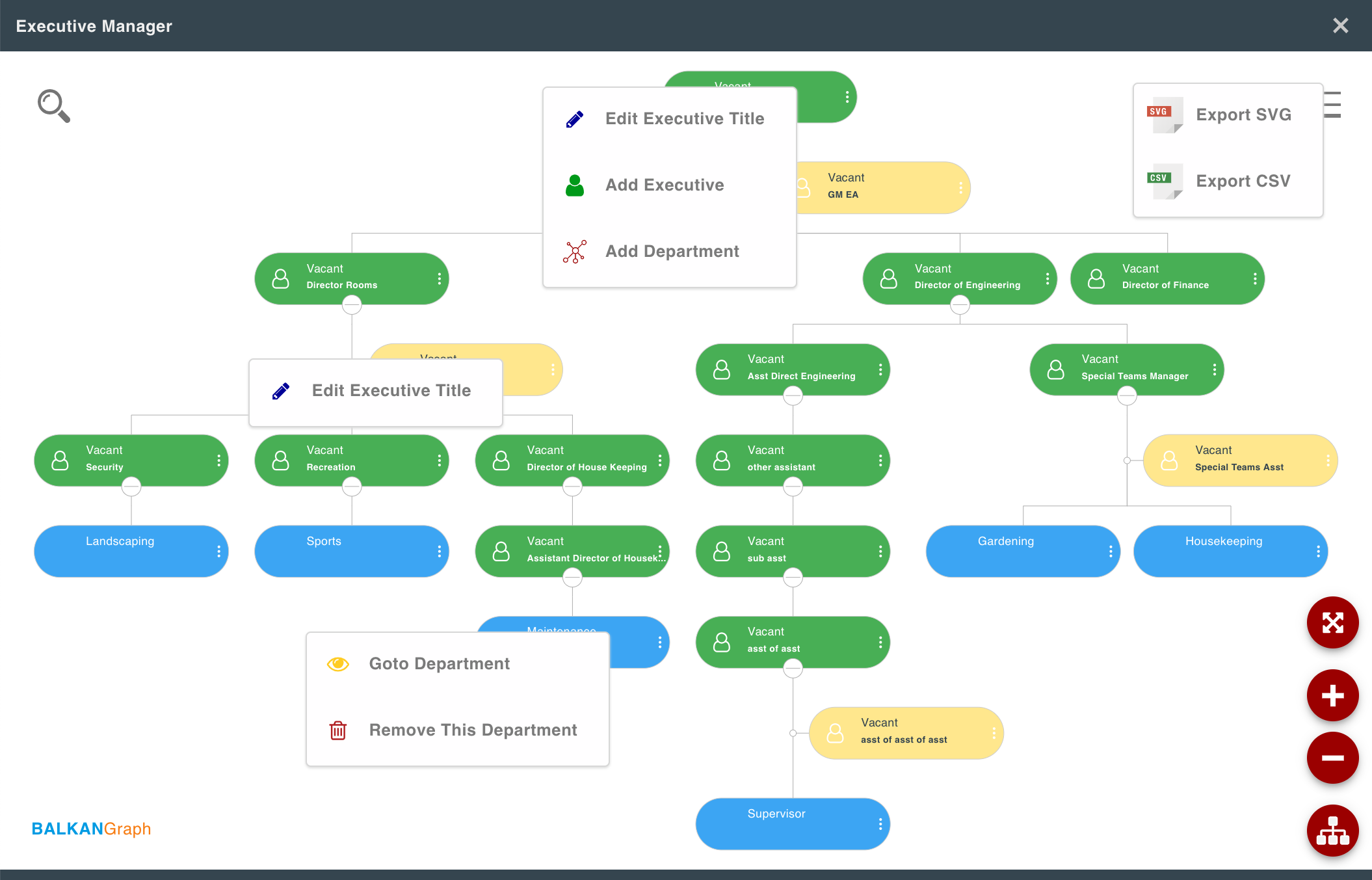
In our Demos you can find some of our customers' templates.
We would be happy if you share your template with us. Please send it as a jsfiddle or HTML file to support@balkan.app.